AISEHack Phase 2 - PM2.5 Forecasting
Episode-Aware Country-Scale Air Pollution Forecasting
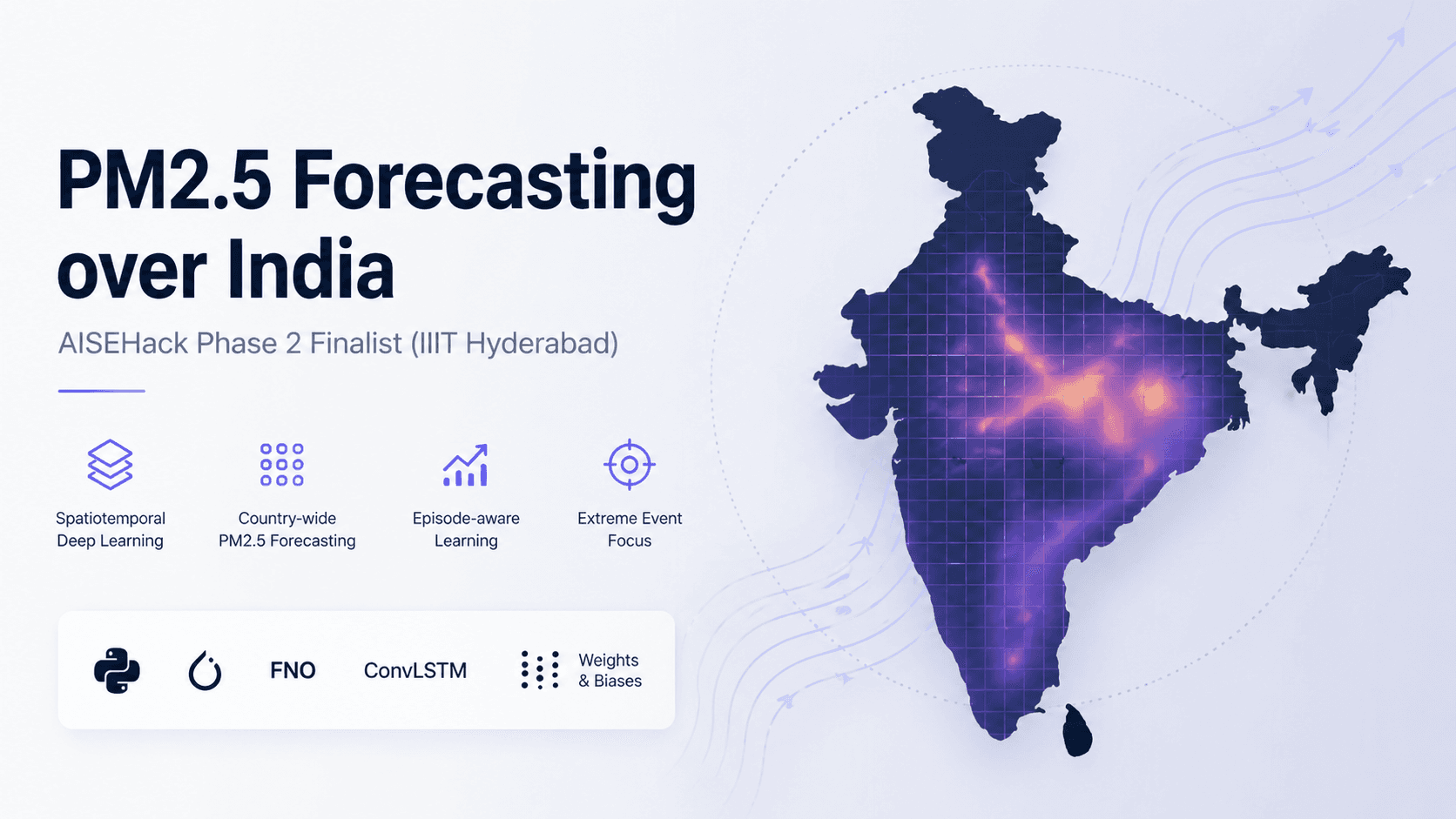
Problem
Short-term PM2.5 forecasting over India is difficult because pollution dynamics are strongly nonlinear and performance on average conditions often breaks down during severe episodes. Phase 2 explicitly evaluates both global quality and episodic behavior while restricting inference to a 10-hour lookback window.
Approach
Built an episode-aware spatiotemporal forecasting pipeline over a fixed 140x124 India grid, predicting 16 future steps from 10-hour history. Trained on representative seasonal months from 2016 and inferred on unseen 2017 months. Used a hybrid deep-learning setup inspired by operator-learning and recurrent spatiotemporal modeling, with validation geared toward both global and episode metrics.
At a glance
Leaderboard score
0.8384
Team
Team Vega
Forecast horizon
16 timesteps
Input history
10 hours
Outcome
Finalists at IIIT Hyderabad
Tech decisions
Episode-aware objective design
Phase 2 scoring emphasizes both global SMAPE and behavior on episodic grid points, so training/validation targeted this trade-off directly.
Spatiotemporal modeling over fixed grid
The task is naturally a sequence-of-fields problem; learning spatial transport and temporal evolution jointly improves stability.
Reproducibility via W&B benchmarks
Baseline and final experiments were tracked as separate runs to compare improvements and avoid overfitting to isolated submissions.
Notebook-first end-to-end pipeline
Competition requires a single executable submission notebook producing `/kaggle/working/preds.npy` with exact shape constraints.